
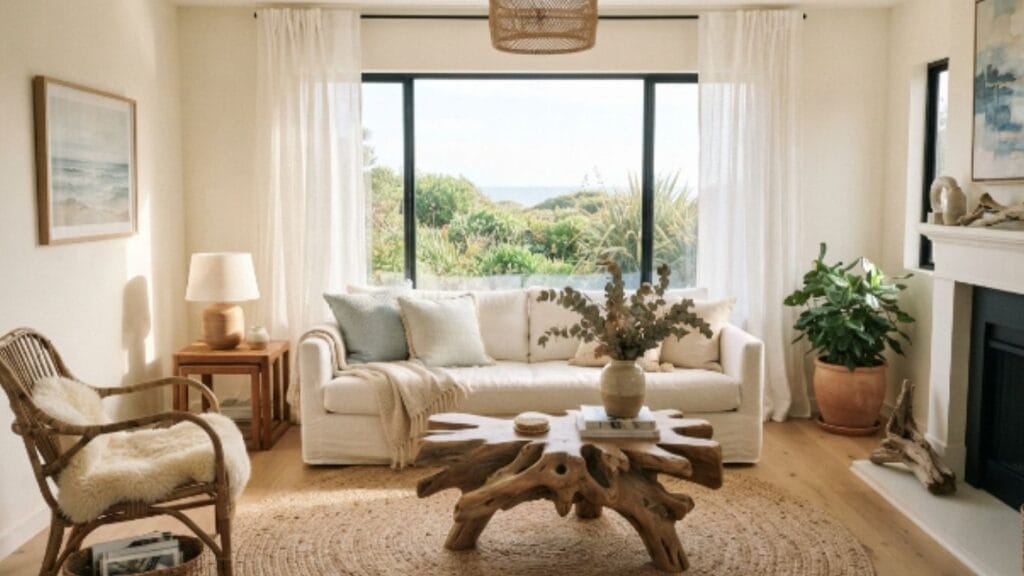
The first time I tried to turn my living room into a coastal living room, I went a little overboard. Blue everywhere. Anchors on the pillows. A ship’s wheel over the couch. It looked less like a beach house and more like a seafood restaurant.
It took a full year of trial and error before I figured out what actually makes a room feel coastal, and it has almost nothing to do with anchors. It’s about light, texture, and a color story that never fights with itself.
If you’re picturing a bright, breezy room that feels like a permanent vacation, you’re in the right place. Below is everything I wish someone had told me before I bought that ship’s wheel.
What Is a Coastal Living Room, Really?
A coastal living room takes its cues from the beach without turning into a theme park. Think sun-bleached wood, linen slipcovers, woven textures, and a palette pulled from sand, sea glass, and driftwood rather than a paint chip labeled “nautical navy.”
The style leans on natural light and airy layouts more than it leans on decor objects. A room with white walls, a jute rug, and one good linen sofa reads as coastal faster than a room stuffed with shells and rope mirrors.
Where farmhouse style feels cozy and rustic, and Scandinavian style feels minimal and cool-toned, coastal sits somewhere warmer and looser. It borrows a bit of both, then adds sunlight.
Why the Coastal Look Works So Well in a Living Room
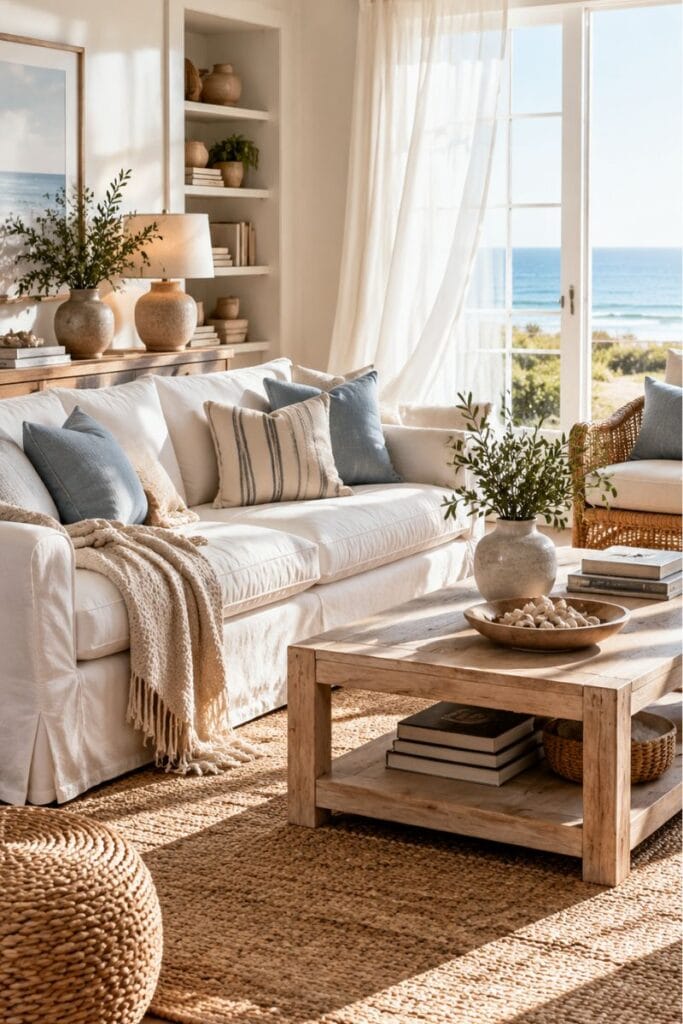
Living rooms carry a lot of weight in a home. It’s where people gather, unwind, and spend the most hours awake. A coastal living room works here because it’s built around comfort first.
The light color palette bounces natural light around the room, so even a living room with one small window feels bigger and airier. Slipcovered furniture and washable fabrics also make sense for a room that sees daily use, spilled coffee, and the occasional dog on the couch.
There’s a psychological piece too. Soft blues and sandy neutrals are associated with calm, and a living room is often the one place in the house meant purely for rest. A coastal palette supports that mood instead of working against it.
Compare this to a bold, dark, moody living room. That style photographs beautifully but can feel heavy after a full day of work. Coastal does the opposite. It feels like exhaling.
Must-Have Elements of a Coastal Living Room
You don’t need every item on this list to pull off the look, but the more of these you layer in, the stronger the coastal feel becomes.
- Woven or rattan furniture pieces (chairs, baskets, or a coffee table)
- Linen or cotton slipcovered sofas in white or soft neutrals
- A natural fiber rug like jute or sisal
- Light wood tones, especially whitewashed or driftwood finishes
- Sheer or linen curtains that let light pass through
- Organic textures: rope, wicker, raw wood, woven baskets
- One or two statement pieces with a subtle nautical nod, kept minimal
Furniture That Sets the Coastal Tone
The sofa does most of the heavy lifting in a coastal living room. A slipcovered linen sofa in white, cream, or pale blue instantly signals the style, and it has the bonus of being removable and washable.
Textures That Add Depth Without Clutter
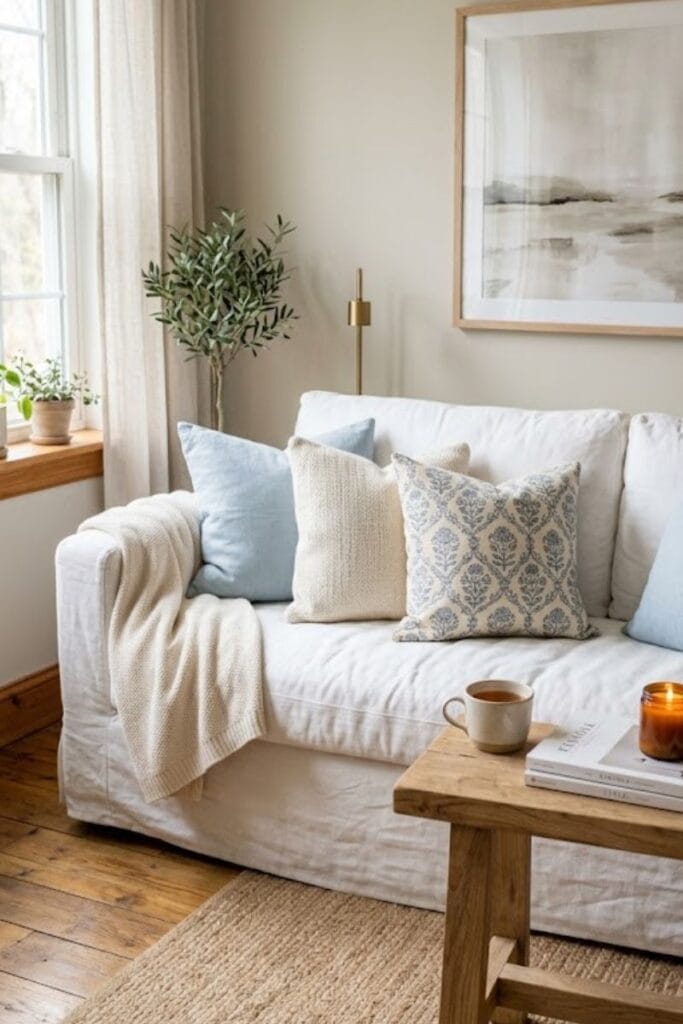
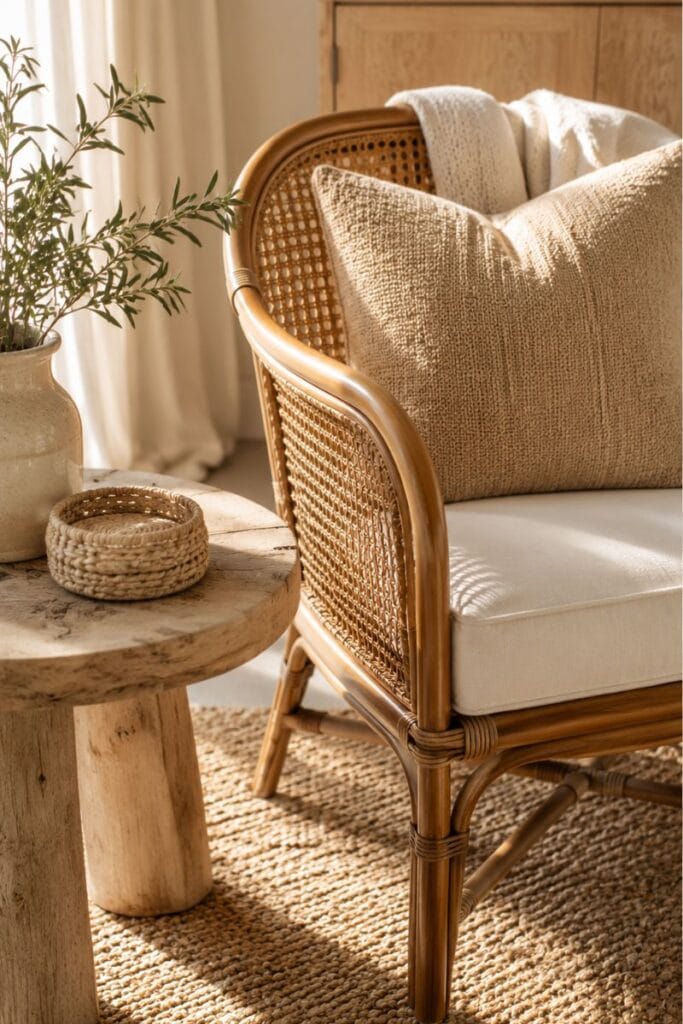
Since the color palette stays fairly quiet, texture is where a coastal room gets its personality. Mix a smooth linen sofa with a nubby jute rug, a woven rattan chair, and a rough-hewn wood table. The contrast keeps the room from feeling flat.
If your walls could use a bit more warmth alongside this coastal look, wood slat accent walls are an easy, budget-friendly way to add natural texture.
Best Color Palette and Materials for a Coastal Living Room
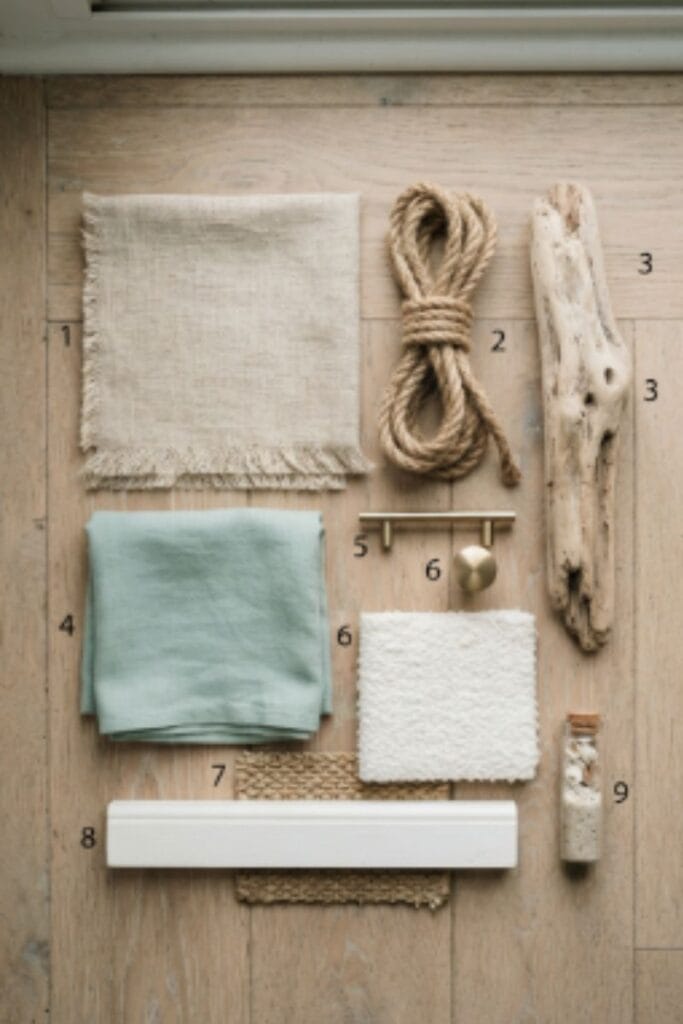
Color is where most people either nail this style or accidentally build a nautical theme park. A true coastal living room palette pulls from the beach itself rather than from a cartoon of the beach.
| Palette Element | What to Use |
|---|---|
| Base wall color | Warm white, soft sand, or light greige |
| Primary accent | Soft ocean blue or seafoam green |
| Secondary accent | Driftwood gray or warm tan |
| Metals | Brushed brass, weathered bronze, or matte black in small doses |
| Wood tones | Whitewashed oak, bleached pine, light rattan |
| Fabrics | Linen, cotton, lightweight boucle |
Keep the ratio in mind: roughly 60% neutral base, 30% soft blue or green, and 10% wood and metal accents. That ratio keeps the room from tipping into either boring beige or costume-y nautical.
Materials matter as much as color. Skip heavy velvet and dark leather here. Instead, lean on linen, cotton, rattan, and light wood, all of which read as sun-washed and relaxed rather than formal.
For a matching statement piece to complete a coastal living room, this guide to modern wall art ideas is worth a look too.
Budget-Friendly Ways to Get the Coastal Living Room Look
A full coastal makeover doesn’t need a full budget. Here’s where to spend and where to save.
| Splurge On | Save On |
|---|---|
| A quality slipcovered sofa | Throw pillow covers (swap seasonally) |
| A natural fiber area rug | Wall art (print your own beach photography) |
| Linen curtains | Baskets for storage (thrift or discount stores) |
| One statement light fixture | Side tables (secondhand wood pieces, lightly sanded) |
A few low-cost swaps that punch above their price:
- Paint one wall in a soft ocean blue instead of repainting the whole room
- Swap out dark curtain panels for sheer linen ones
- Add a jute rug over existing flooring instead of replacing it
- Bring in a few woven baskets for storage that doubles as texture
- Layer in secondhand wood furniture and lightly whitewash it yourself
5 Real Coastal Living Room Examples
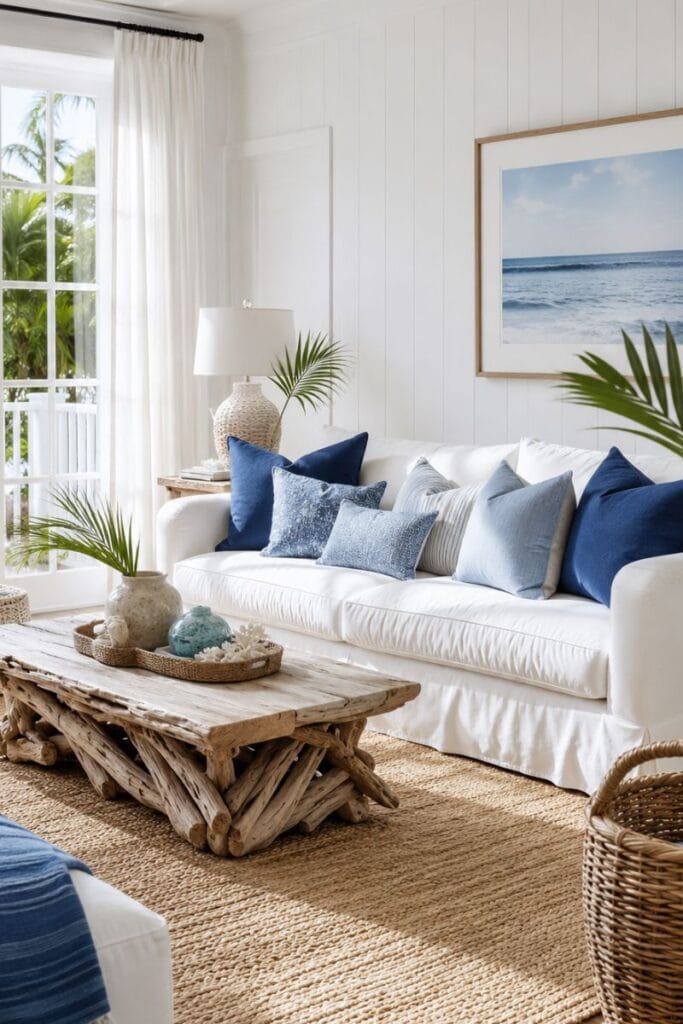
Room and Look: The Classic Blue and White Living Room
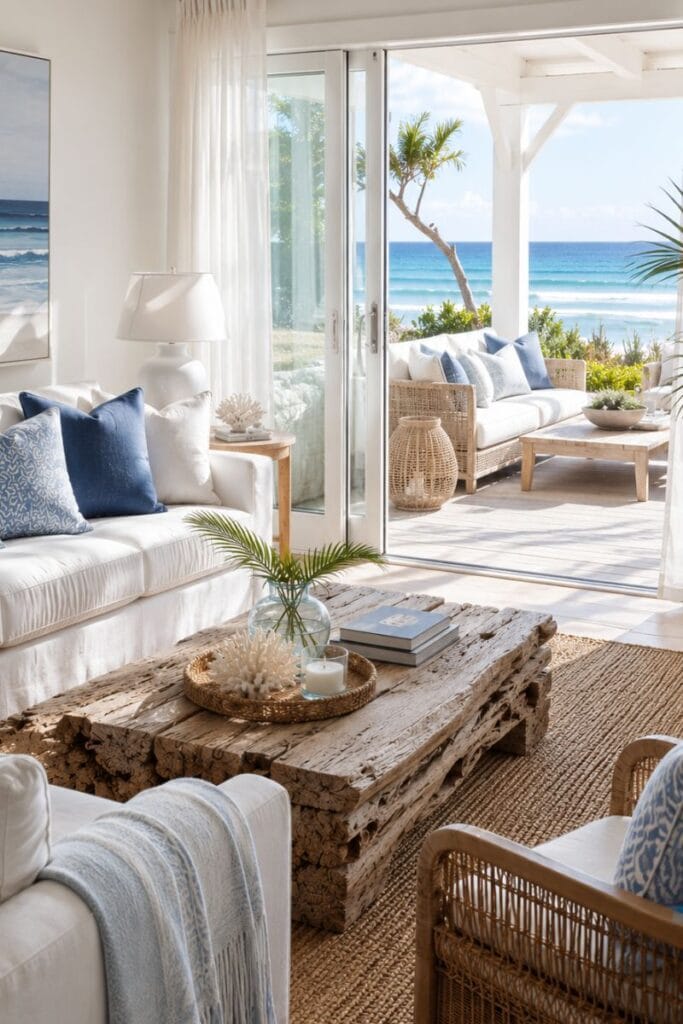
A crisp white sofa anchors the room, with navy and sky-blue pillows layered on top. White walls, a driftwood coffee table, and a woven rug keep the space feeling open rather than themed.
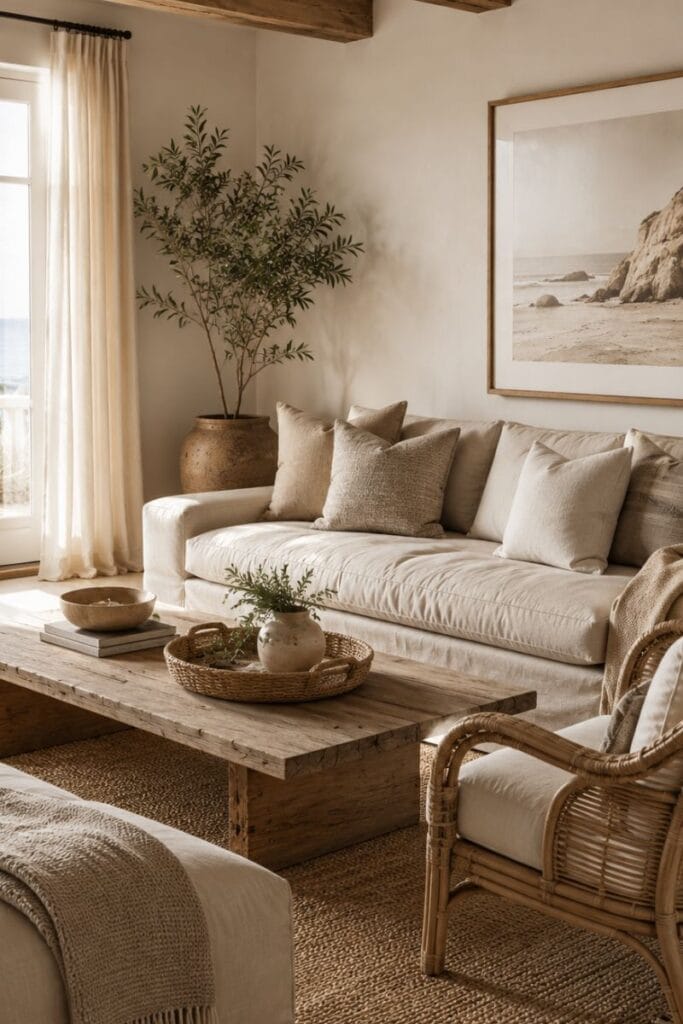
Room and Look: The Neutral Sand-Toned Living Room
This version skips blue almost entirely. Sand, tan, and warm gray dominate, echoing dunes more than ocean water, with texture doing all the work through linen, rattan, and raw wood.
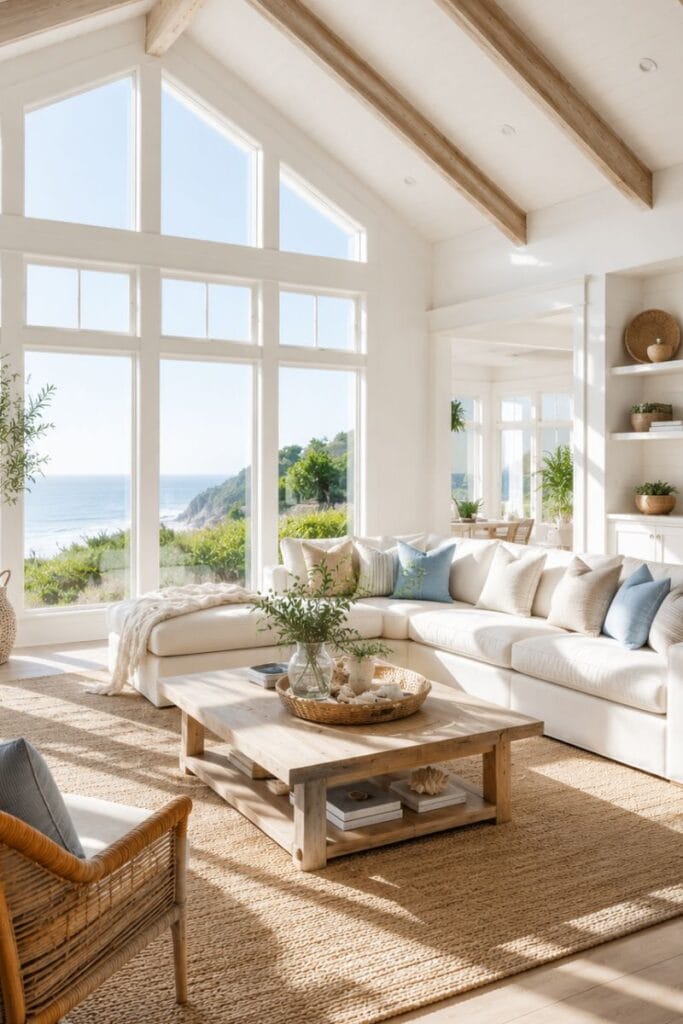
Room and Look: The High-Ceiling Airy Living Room
Vaulted ceilings and oversized windows let this room lean into light instead of color. White walls and pale wood keep the eye moving upward, making a modest footprint feel expansive.
Room and Look: The Indoor-Outdoor Living Room
Sliding glass doors connect this living room to an outdoor seating area, blurring the line between inside and out. Furniture here uses weather-resistant linen so the transition feels seamless.
Room and Look: The Small-Space Coastal Living Room
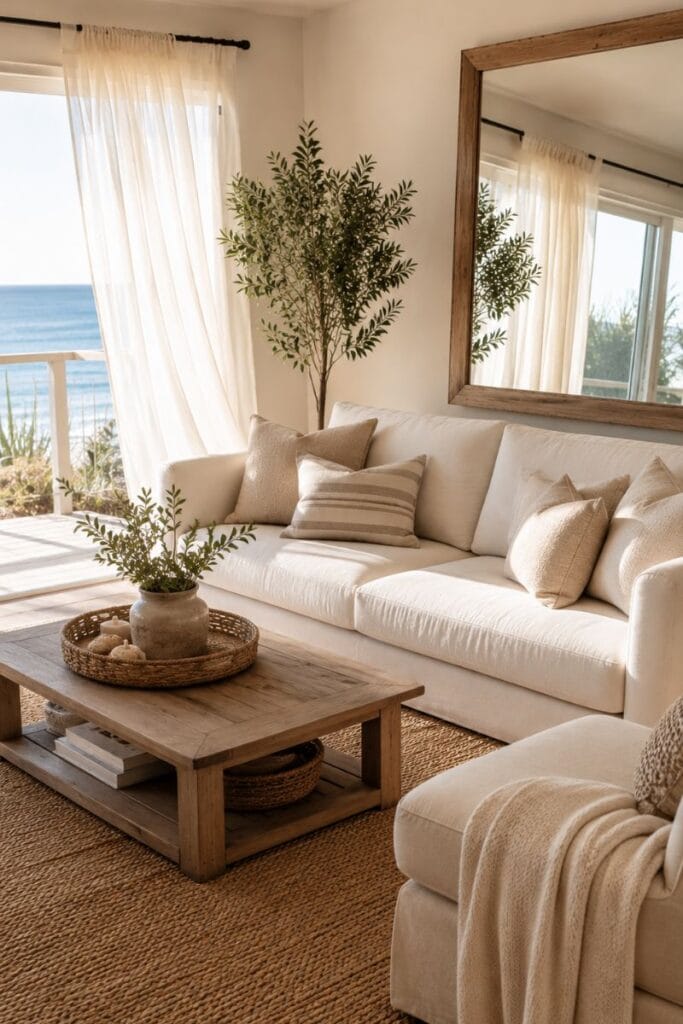
Light colors, a mirror to bounce natural light, and low-profile furniture make this compact living room feel far bigger than its square footage, proving coastal style scales down as easily as it scales up.
Common Coastal Living Room Mistakes to Avoid
Even with a clear plan, a few missteps show up again and again.
- Overdoing the theme. Anchors, ship wheels, and shell collections on every surface push the room from coastal into costume.
- Choosing the wrong blue. Bright, saturated blue can read more like a nursery than a beach house. Stick to soft, muted tones.
- Skipping texture. An all-smooth room with no rattan, linen, or wood grain ends up flat and cold instead of relaxed.
- Blocking natural light. Heavy drapes defeat the entire point of the style. Let light move through the space.
- Ignoring scale. Oversized furniture in a small coastal living room crowds out the airy feeling the style depends on.
Styling a Coastal Living Room in Small vs. Large Spaces
Small Coastal Living Rooms
In a smaller footprint, keep furniture low-profile and light in color so nothing visually crowds the room. A single statement rug and one accent color go further than several competing patterns. Mirrors placed opposite windows help stretch the light across the whole room.
Large Coastal Living Rooms
A bigger living room has room to layer, so this is where a second seating area, a larger jute rug, or a pair of rattan chairs makes sense. Watch out for the opposite problem here: too much open space with too little warmth. Groupings of furniture, layered rugs, and varied wood tones keep a large room feeling inviting instead of echoey.
Where to Shop for Coastal Living Room Pieces
- Furniture: Look for slipcovered sofas and rattan chairs at mid-range home retailers, or search secondhand marketplaces for solid wood pieces to lighten with paint or wash
- Rugs: Natural fiber rugs (jute, sisal, seagrass) are widely available at both budget and higher-end retailers
- Textiles: Linen curtains and cotton throw pillow covers are easy to find seasonally and simple to swap out
- Decor accents: Woven baskets, driftwood-finish frames, and simple glass vases keep the coastal feel without tipping into theme territory
Frequently Asked Questions
What colors work best in a coastal living room?
Soft ocean blue, sand, warm white, and driftwood gray form the core palette. Keep saturated, bright blues to a minimum so the room reads relaxed rather than bold.
Do I need beach decor to make a room feel coastal?
No. The style comes through color, texture, and light far more than through literal beach objects. A few subtle accents go further than a room full of shells and anchors.
What’s the difference between coastal and nautical style?
Nautical style leans on navy, red, rope, and literal boat references. Coastal style is softer and more neutral, drawing from sand and sea glass rather than a ship’s deck.
Can a coastal living room work without natural light?
It’s harder, but not impossible. Light wall colors, mirrors, and warm-toned lighting fixtures help mimic the airy feel even in a room with limited windows.
What flooring works best with coastal style?
Light wood floors, whitewashed boards, or light-toned tile all pair well. A natural fiber rug layered on top adds texture without darkening the space.
A coastal living room isn’t about how many beach objects you can fit on a shelf. It’s about light, texture, and a palette that feels like it was pulled straight off the shoreline. Start with one linen sofa and a jute rug, and the rest of the room tends to follow.
